
Two blogs ago, I wrote about Anchoring bias. That is, we tend to make sense of the outcome by comparing it to an anchor.
A million dollars is not equal to a million dollars. If yours is a rags to riches story, then a million dollars is one thing. If you had ten million dollars to begin with and you lost nine million, then the remaining million is another thing. The first is a thing of joy because the anchor is 0. The second is a sad reminder of the lost nine million. We use anchors to make sense of the million dollars.
In my previous blog, I wrote about the need to have light beliefs so that when facts change or contexts change, we must change our beliefs. A friend asked me- what beliefs have I changed? That list is long and I will milk it to write a few blogs. (You have no idea how hard it is to come up with ideas for blogs.)
But for today, I will share this: we need to anchor to the future, not to the past.
—
During 2020, a company I studied was CDSL. It was a fascinating business. Essentially it is a digital infrastructure that we use every time we buy or sell. To be more specific: it is a digital infrastructure that we use every 4 times for every buy – sell. And we pay a toll, without a thought. So when the number of users multiplies, what would happen to the profits of CDSL? It would just explode!
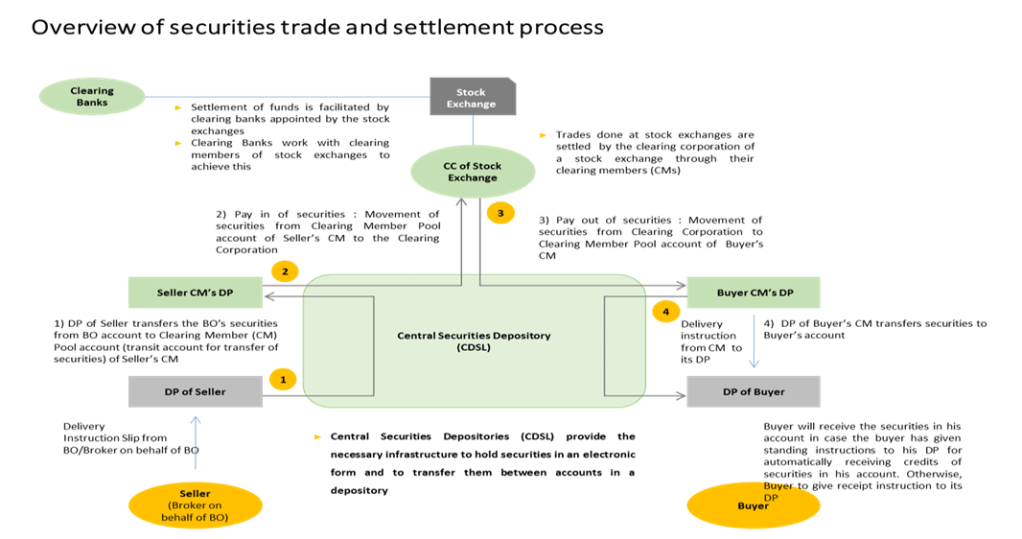
And it’s a duopoly business and all the heavy lifting of getting more users is done by brokers like Zerodha, Groww and so on. CDSL just needs to make sure that servers are working fine, the lights are on and the coffee vending machine is working fine. No sales. No marketing. No collections department.
In 2020, I discussed it with a friend and then chose not to buy it. The stock price was Rs 100 then. Very quickly it went to Rs 200.
Another friend advised me to study it again and if it made sense, be willing to pay a higher price to buy it. But I told myself: if I was not buying it at Rs 100, surely I won’t pay double the price and then I let it go!
Rest is misery.
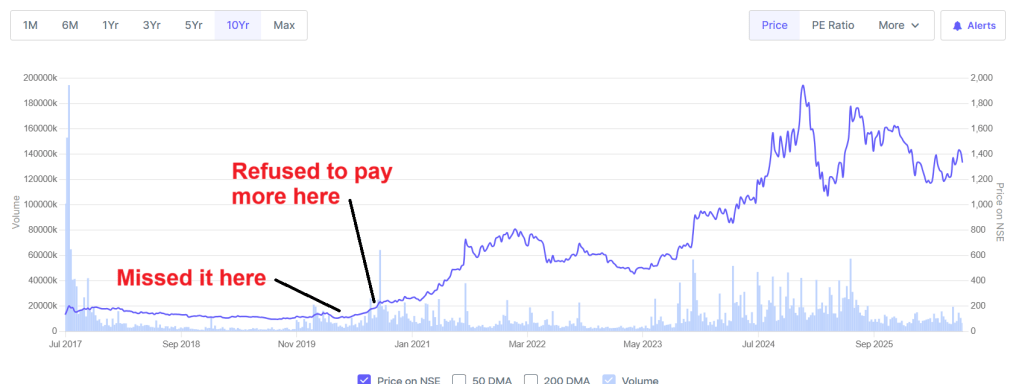
So: what was the mistake in my thought process? I was anchored to the past instead of anchoring to the future.
You see, the past is easy to see and easy to judge and hence an easy anchor. But also a wrong anchor because the past is gone. The price at which something was available in the past is an illusion and we should let it go. This is sunk cost fallacy.
Instead, what matters is what lies ahead: the future. Is the future opportunity large? And is that the future we want? I had done my homework and I should have told myself that in the future that there would be more users, buying and selling more which would mean massive profits for a fixed-cost business like CDSL. And therefore, if I have to pay a higher price, I should be okay with that.
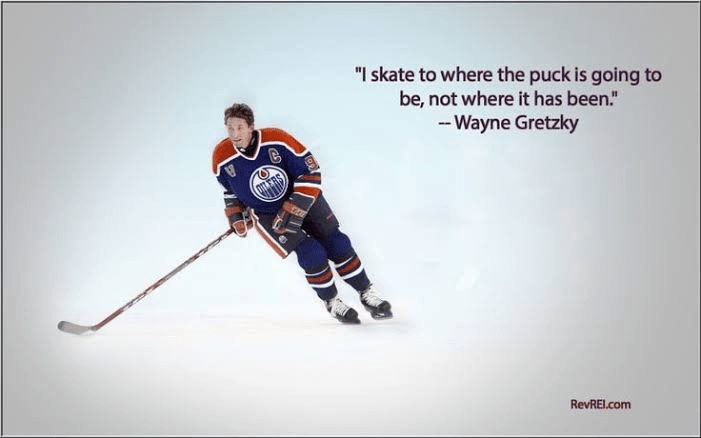
We all have regrets – we should have done this or avoided that and so on. Having regrets is unavoidable. But, to get lucky in life forget the past and go where the action is today/ or where the future is getting made. Like I said: the correct way to think about opportunities is to assess their future size. What you paid for them is immaterial.
I don’t spend much time regretting the past, once I’ve taken my lesson from it. I don’t dwell on it.
-Charlie Munger
We all are learning, modifying, or destroying ideas all the time. Rapid destruction of your ideas when the time is right is one of the most valuable qualities you can acquire. You must force yourself to consider arguments on the other side.
Charlie Munger
—
Now, let me narrate another incident, where I fared better.
There was water seeping from the house above to mine. The neighbor above and I had a bit of tiff about it.
Then I thought about the situation and I realized that for as long as I own my current home, I will be dependent on him. But he will never be dependent on me. And as the building ages, there will be more water seepage incidents. Therefore, if I needed him then, I would need him even more in the future. And if there was going to be more seepage in the future, then without his help, I may never be able to sell my apartment.
I thought about the future where I needed him. I did not think of the past.
And therefore, I called the neighbor, apologized and even offered to share the cost of future repairs and so on.
By anchoring to the future, I was able to see my situation more clearly and that allowed me to take the correct decision.
—
I recently invested in a company trading at 60 times earnings but growing at 40% every year for the next few years. Like CDSL, I missed it when it was much cheaper. And, the funny part was I sold one of my holding which was trading at 6 times earnings to buy this company. Selling a cheap company to buy an expensive company, felt like religious conversion. But the future of the first company seemed so much better than the second. And like I said : beliefs have to be loosely held and discarded when context changes.
—
I’ll leave you with this thought: quality of our life depends on the quality of our decisions.
-Cheers!


Very nice. Really a good one.
LikeLike
Thank you Bhai
LikeLike