
We understand comparisons better than actuals.
Suppose a company clocked Rs 1000 Cr in sales, we don’t know if it is good or bad. And therefore we compare it to it’s own performance in the previous year or to other similar companies. And then you get a sense, if this 1000 Crs is good, bad, even or something else.
Comparison is how we interpret the world. It is deeply wired into us.
You may think becoming a millionaire is cool. But during the Global Financial Crisis a millionaire killed himself because he was a Billionaire before that. Your anchor may have been say $100,000 and so becoming a millionaire seemed cool. His anchor was $1,000,000,000. So while a million dollars is the same, the interpretation of that outcome vis-a-vis the respective anchor was different.
There was this very famous example of The Economist and it’s subscription plans. There were 3 plans:
- Option 1: Digital only: $59
- Option 2: Print: $125
- Option 3: Digital+ Print: $125
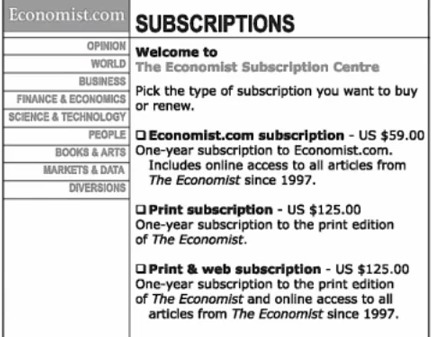
You may think that The Economist is stupid enough to offer Print + Digital (Option 3) at the same price as Print only (Option 2). And you tell yourself, that you will play on The Economist’s stupidity and choose Option 3.
But it is you who is being played. The Economist deliberately introduced a decoy (Option 2) to make Option 3 look fantastic. Most people who would have earlier opted for Option 1 would now opt for Option 3 and end up paying more. Simply because of the decoy.
Here is a joke.
Two beggars are sitting side-by-side on the sidewalk just outside St. Peter’s Square at the Vatican. One of them holds a cup with a Jewish Star, and his cup is nearly empty. The other holds a cup with a large Christian Cross, and his cup is overflowing with cash.
A concerned Catholic priest walks out of the Vatican, spots the beggar with the Jewish Star, and takes pity on him. He walks over and says, “My poor fellow, don’t you understand? This is the Vatican! People are not going to give you money if you display a Jewish Star. In fact, seeing the Cross next to you, they will probably give the other beggar extra just out of spite.”
The beggar with the Jewish Star listens intently, turns to the beggar with the Cross, and says “Moishe, look who’s trying to teach us brothers about marketing!”
And one more:
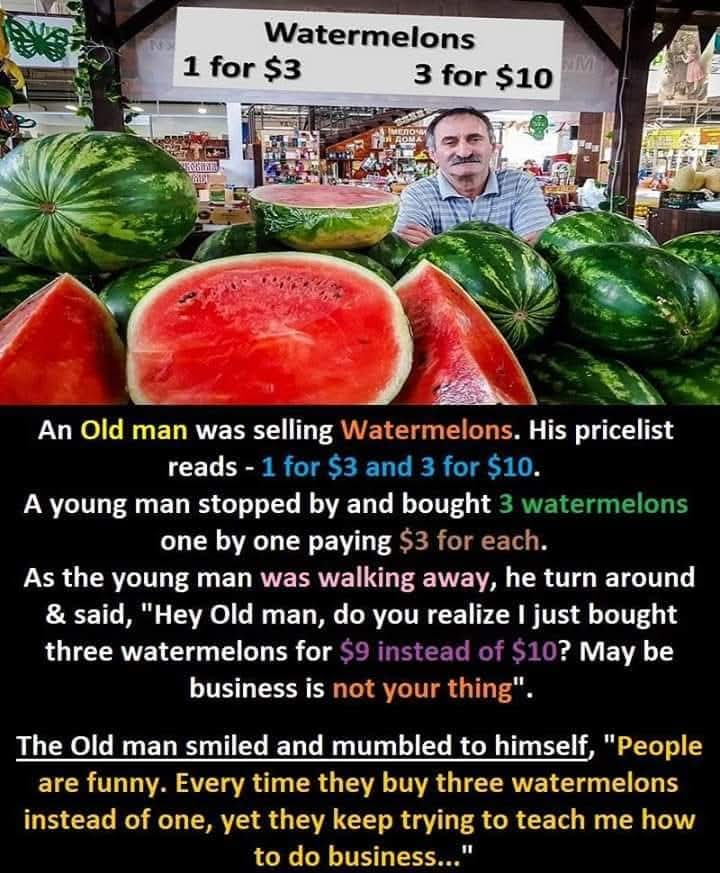
Notice, the same pattern. The beggar with the Jewish Star is the decoy. The option to sell 3 watermelons for $10 is the decoy. They are there just to make the other option look good. People who wouldn’t have normally tipped the beggar or bought watermelons, would now do so. So, who is being played here?
This is such a powerful idea. You can make people feel smarter while actually fooling them.
I put this idea to work, once.
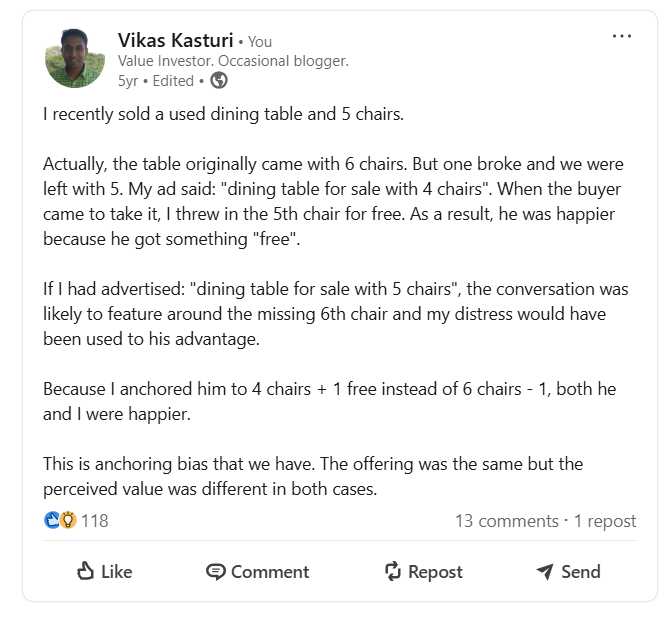
So, you see, only to a Mathematician or a very rational Economist, 4+1 = 6-1. But humans are not wired to think rationally. “+” can mean free or more and is therefore better than “-“.
—
If you like reading about ideas, you will enjoy putting them to work even more. Try it.
-Cheers!


So true.
Now I am getting motivated to try such things. On others, of course .
LikeLike
Thank you for reading my blog, Bhai.
LikeLike