
Humans have been on earth for 4 million years. Assume 4 million years to be equivalent to a 24 hour clock. It turns out, that of those 24 hours, we have spent 23 hours and 56 minutes as hunter gatherers! Let that sink in for a bit. Twenty three hours fifty six minutes as hunter gatherers and just four minutes as part of civilization! Our minds and bodies are built for the stone age but we now live in space age.
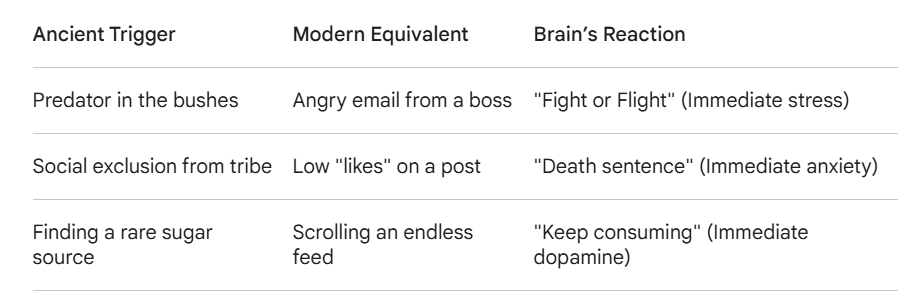
One of the evolutionary biases we have is immediacy – that is, you and I are programmed for the here and now. In the jungle, if you saw a fruit, you ate it immediately. If you hunted an animal, you ate it immediately. If you saw danger, you ran immediately. You didn’t plant a seed and wait for it to become a fruit bearing tree. There were so many fruits already available, so why wait?
This evolutionary bias for immediacy is both good news and bad news. First, the good news.
#1 The good news
The Toyota Prius was among the first hybrid cars ever. It used a mix of battery and petrol to power the car. But the killer feature, in my opinion, was that it gave real time feedback to the driver about his/her driving pattern. Step on the accelerator too much and you burn more petrol and consequently you would see your mileage drop; drive at a consistent speed and you’d see the car being powered by the battery and being rewarded with increased mileage.
We humans love this kind of real time, immediate feedback; it alters our perspective like nothing else.
In Bangalore, you can throw trash where you want and nothing happens. In Singapore, if you do the same, you will immediately be named, shamed and fined. This real time feedback changes behavior for the better. Good behavior (as in Prius) is immediately rewarded with extra miles. Bad behavior (in Singapore) is immediately punished.
We have a small group of investor friends who meet virtually every fortnight, and have been doing so for 6 years. But absenteeism was a big problem. Low turnout leads to low motivation for those who attend. We had a written code of conduct that we will maintain our attendance at a minimum of 70%, yet the reality may have been closer to 50%. So, instead of changing friends we changed our friends we introduced one small tweak. Just one. We started putting out an attendance tracker and this was published immediately after the meeting. Now, everybody could see who is attending and what their attendance levels were. Overnight, Bangalore changed to Singapore. Guys who were irregular in attending, now made it a point to attend even if they were in the bathroom (thank god for the mute button). But you get the point – the immediacy – the ability to see a direct correlation between action and reaction was a behavior changer.
Investing is a long game, where effort is frontloaded but rewards are backloaded. So how do you get people interested enough? How do you get kids interested? For my own kids I opened a mutual fund accounts in their respective names; this was important because it feels more personal. Then, I have been investing a small sum of money every month on their behalf. And finally, most importantly, I show them the dashboard every month – to bring in the Prius kind of feeling. I show and say to them: here is your input and that is your output.
So anytime my kids get some cash, like a birthday gift or prize money, they add it to their account. The sums are small, but the change is big.
Neither Prius drivers, nor my kids fully comprehend everything happening behind the scenes. But seeing the dashboard, they sense that something good is happening. That is the moment of truth for them. And that provides a positive feedback loop and reinforced desirable behavior.
Takeaway: Dashboards are awesome. They give you a sense of input-output, action-reaction and give us a positive reinforcement to keep going. Even long journeys like losing weight, getting fitter, investing – all become more engaging with a dashboard. It plays to our evolutionary bias for outcomes.
# 2 The bad news
Suppose there is a long time-delay between input-output, how do we behave? Terribly.
Bad eating habits and smoking have short term pain gains built into them, which reinforces that behavior. Exercising, reading, meditating don’t have short term gains and hence we tend to kick those cans down the road.
People who study demographics will tell you that for a country’s population to remain stable, the total fertility rate (TFR) must be 2.1. When the TFR dips below 2.1, the population will decline. But the decline will happen say 20 to 30 years later. Here is data from Japan and China, as provided by Gemini.
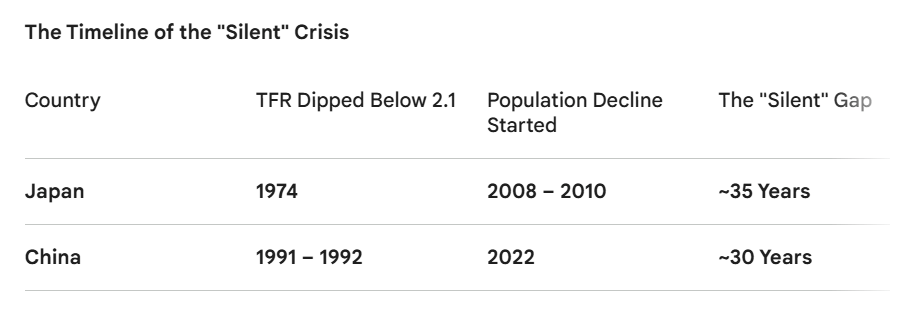
I watched a video about Japanese population problem, where planners could sense way back in the early 2000s that Japan was going to have a population problem in 2025, yet politicians did what politicians do: kick the can down the road. They were solving only for the present and not for the future. After all, the politicians are judged on their present performance and hence they have little incentives to solve problems for future politicians. In India, for example, fixing the public education could take 15 years but only a statesman would think of solving such problems.
On the other hand, politicians have every incentive to say borrow large sums of money, the burden of which will fall on future generations. This is the equivalent of smoking for today’s upside and letting somebody in future get the downside.
My friend Ankit Kanodia has a good borrowed line: Paise jyada chahiye ya jaldi? People will say jyada, but their behavior is jaldi. Another friend of mine, got shares of D-Mart via the IPO in 2017. I was just starting my career as an investor and I advised him to hold onto it because the promoter was (and is) a respected investor. Instead, my friend sold it and pocketed a few hundred Rs of gain per share. He became richer without getting wealthier. I say this because D-Mart is up 7x since IPO!
Two months ago, a neighbor asked me about silver because silver was having a great run. If it was two years ago, he would have asked for stock tips. If it was 2018, he may asked for my advice on Bitcoin. We want the asset that is going up. We only want the asset that is going up. If that asset is silver, then we want silver. If it is Bitcoin, we want Bitcoin. If it is AI/ Data Center stocks, then that is what we want. You see, evolution has designed us to be active, momentum investors, not patient value investors. And that bias for immediacy is a handicap in my kind of investing.
So, if you are the kind of investor who has 10 competing ideas at any given point of time, then ignore everything I have to say and continue doing what’s working for you. But if you are not, then do consider the following analogy.
Anthony Deden is an investor based in Switzerland. And he once gave an analogy of a date farmer that he met. The farmer told him that good quality dates take 40 years. And the farmer is today reaping the benefits of what his grandfather and father sowed. And he himself was sowing seeds for his future generations.
Good things take time. A theme of investing that I like is metamorphosis. I like to look for companies whose balance sheets, margins and cash flows are transforming. But because the nature of the market is to be impatient, you and I can buy such opportunities at a somewhat cheap price and wait for the price to correct upwards.
A company that this happened in is Garware Hi-tech (I was too naive to participate in it). In the table below, I have shown a snapshot of the company – how it was in 2020 and then in 2025. Notice how while the revenue was grew, the operating profit margin increased. That is, with scale, there was more profit per rupee of sales. Sales growth led to a higher profit growth and cash flow growth. And the improved cash flows meant that they paid off all their debt. The company seems to be doing something very special because it is now able to demand to get paid sooner (8 days now vs 21 days earlier). This is some big transformation and did not happen overnight! But if you could patiently wait for such transformations, you would be rewarded 15 to 20 times your investment.

If you find waiting arduous, then you can create tables like the one above for yourself to see the improvement in business. And surround yourself with examples such as the one above. It’d be like your dashboard. That way, you can see progress while waiting for the proceeds.
—
We are programmed by nature to be impatient, to favor the now vs later. Compound Interest was an invention of the civilized world and hence nothing in our brain is wired for it. However, if you cultivate patience and let time do the heavy lifting, you will see results beyond wonder.
Cheers!
 Interest upon Interest
This is excellent and well thought out blog.
LikeLike
Thank you sir.
LikeLike