
What important truth do very few people agree with you on?
– Peter Thiel.
This is a tough question because:
- First: you need to have thought of some important truths yourself
- Second: through observation you should know that people don’t agree with that important truth
According to me, people don’t think about survival as much as they should. People may agree with me, but their own behavior doesn’t agree with them. Here are some examples.
Example 1: The stupid young conqueror
At the Grand Canyon, there are warning signs everywhere discouraging people from doing things like hiking down and up. Why? Because, it is 4,500 ft down and each way is a 4.5 mile hike. Of the people that are stupid enough to attempt it, every year some 350 people are rescued. And unlike most hikes, here you are going to go down first and then climb back up.
I was 28 and fit. I went to the Grand Canyon along with friends. And we planned to go down the Canyon to the Colorado river and climb back up the same day! What about the warnings? Those are for the oldies.
And was I humbled, that day? I struggled on my way up. I had cramps and I barely made it back. I didn’t want to be one of those oldies who needed to be rescued and yet that is what almost happened to me.
- Did I take life for granted? Hell, yes!!
- Was I thinking about survival? No
Example 2: The fatal bridge
There was a 100 year old bridge over Indrayani river that was not fit for use. Warning boards had been installed asking people not to use the bridge. I am not 100% sure but in my mind this is how it played out.
First, some people walked over the bridge and nothing happened. So they did it again and nothing happened. And pretty soon, almost everybody used it over and over again and still nothing happened. Even two wheelers started using it.
And one day there were a hundred people including tourists and two wheelers on the bridge. And that day, the bridge finally collapsed. Four people died and many more injured.
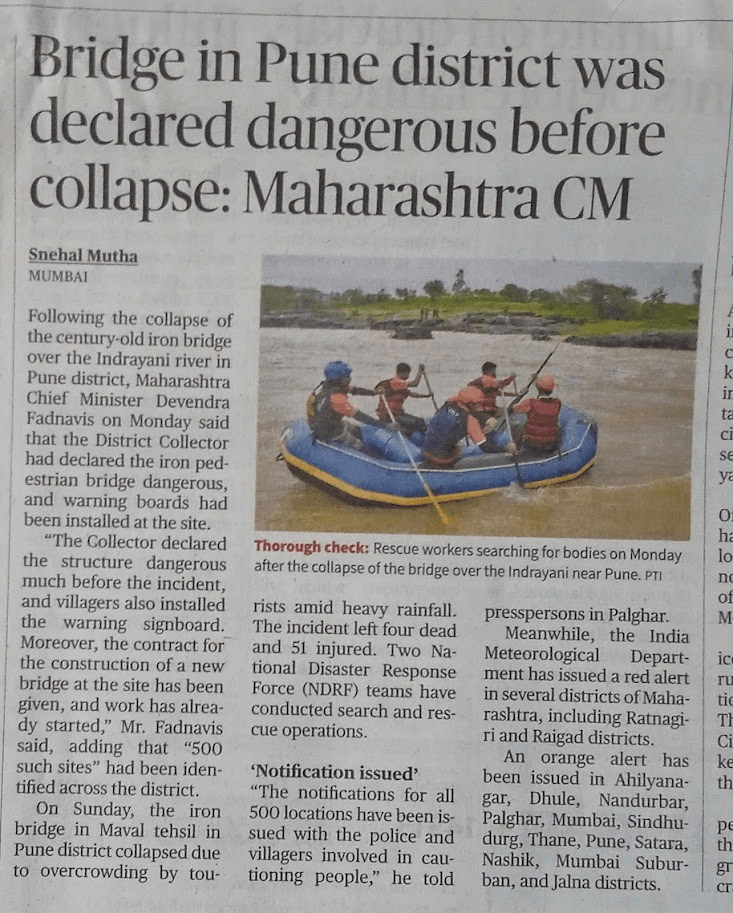
All this, when there were warning boards telling the bridge is not safe to use. Just as I ignored those warning boards, these people did too. So why did people not pay heed? Because they had used this dangerous bridge before and nothing had happened and so they continued to do it.
- They became blind to the existence of risk.
- They underestimated the downside of the risk.
This reminds me of what Taleb wrote in one of his books. He said when you play Russian Roulette, say one bullet in a thousand chambers, you become numb to the existence of risk after a while. You forget that there is a bullet and you forget what that bullet can do.
Last year, I wrote about the driver who drove badly at midnight and he said: I have done this many times before. He may have done it many times, but I don’t want to be anywhere near when he crashes for the first time. And that is why I am not a big fan of track records.
Example 3: Stampedes everywhere
There was a tragic stampede in Bengaluru recently. Before that there were stampedes in Tirupati, in Kumbh Mela and at a screening of Pushpa 2 in Hyderabad. The patterns were very similar in all the tragedies:
Large crowds + Deprival super reaction (desperation)
So, my question to you: why even go where there is such a crowd?
Example 4: LAS, alas!
Say you need money. You can pledge your house or gold and borrow money. You can also pledge your shares and raise money (called by a very innovative name – “Loan Against Shares” or LAS). I think, they allow you to raise money so that you can use it to for some emergencies instead of having to sell it.
Should you use LAS and invest that money again in shares? After all Charlie Munger has said that he invested 120% of his net worth in one stock. Should YOU do it? (Even some of my friends have had these thoughts especially in a bull market.)
I was listening to an interview of Prof. Sanjay Bakshi and he said in 2004, he had borrowed money against shares and invested that money too in buying more shares. You should also know that in 2004, BJP lost to the Congress by a mere 7 seats! And Congress and allies formed the government and the stock market tanked. Prof. Bakshi got a call from his lenders asking him to furnish more collateral and he did not have more collateral (aka no slack). And so the lenders sold his shares (margin call). And within a few days of selling, the stock price bounced back – except that Prof. didn’t own those shares anymore and he couldn’t participate in the upside.
Similarly, a very notable investor who was profiled in the book Masterclass with Super Investors – he too had a margin call during the Covid crash.
So – what makes you think you will be as lucky as Munger and not as unlucky as the other two gentlemen?
At this juncture, I would say an unpopular thing: it’s okay to get rich slowly rather than get poor quickly. For Compound Interest to do it’s magic, you need to supply time aka survival. And to survive you need to have slack, have adequate diversification and less envy.
—
I don’t remember where I read this analogy but it has stayed with me. Imagine life to be like a game of snakes and ladders. For every die roll, there are only three possible outcomes:
- Encounter a ladder and zip through
- Encounter a snake and fall back
- Encounter neither snake nor ladder and move forward slowly
Because most people are in a hurry to get rich, they want only three things: ladders, ladders and ladders. However, a simpler strategy based on Charlie Munger’s “All I want to know…” is to simply avoid all snakes. That’s it! Think about it: if you focus on avoiding snakes, you WILL win.
Focusing on avoiding setbacks like large losses due to concentration, margin calls and selling during bull markets WILL help you win. Sure, life won’t be as exciting as zipping through ladders, but then your probability goes up immensely. This kind of a defensive way of thinking is another thing that most people don’t get. (I was once invited as a guest to an interview and I described myself as a timid investor. And a person from the audience said: don’t invite such people again. LOL! ).
That is why I said: Charlie Munger and Warren Buffett have done some disservice by talking about the time they concentrated or when they used leverage and survived. Even notable investors such as above, have not always been lucky.
—
Yaksha: What is the greatest wonder?
Yudhisthira: Every day, people see others dying, yet believe they are immortal.
Cheers!


Every example taught me something here.
The fatal bridge example makes me cautious about the current equity market.
The recent stampede in Bengaluru was indeed tragic. I will especially avoid when such gatherings happen in a closed environment, like stadium in this case.
When the excitement of the crowd is high + when the event is free + when there are narrow entries into the venue (here the gates) + when such events happen at a short notice – it is better to avoid it.
LikeLike
Thank you Vasanth. You said it better than me.
LikeLiked by 1 person
Dear Vikash,
Very well written. Everytime i read about snake and ladder example, i tend to slow down and think over the game of life and investing. Avoiding Risks in wealth Journey are bound to add to wealth over time..
Thanks for sharing..
Regards,
Manoj Sharma
LikeLike
Thank you Manoj.
LikeLike
THE BEST post from your lot ! Thanks for writing !
LikeLike
This post was the best Vikas !! Thanks for writing !
LikeLike
Thank you.
LikeLike