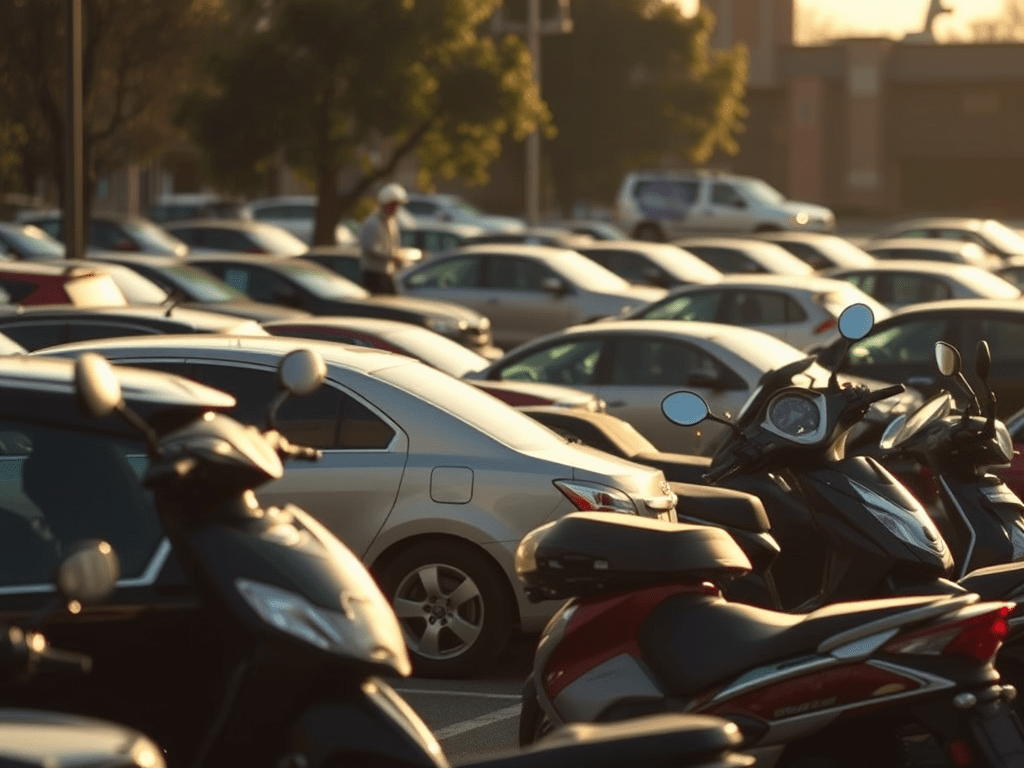
My neighbor has a parking slot that is the same size as mine. I have a two wheeler and a car. He has four two wheelers and a car. And so he has trouble moving his car in and out. Irony is that, his two wheelers are rarely used while the car is regularly used. And hence he struggles daily. (The solution is also easy.)
Parking space is a limited resource. So is time.
Sometimes our most important priority struggles because we have filled the limited resource (time) with many, many smaller priorities. Responding to X’s email and Y’s WhatsApp and Z’s Instagram pic and discussions about what he said and she liked are all like those useless two wheelers.
Seeing my neighbor’s parking slot is a daily visual reminder to myself to allocate my time and energy wisely.
—
I asked my son to imagine that he was on the way to the airport to catch a flight that would take him to California where he would join Nvidia. On the way to the airport an idiot starts to abuse him and annoy him. I asked him what would he do?
He said, he would ignore the abuses and focus on catching the flight that would take him to a wonderful future.
This is India’s decision too – to not engage with a lousy country and instead focus on it’s own progress and development. We did what we had to and we are not interested in a long drawn war which will be akin to choosing to miss the flight just to score a win over an idiot.
This was a fantastic and rational decision on behalf of the leaders, in my opinion. Sometimes, we must walk away because our time, energy and opportunities awaiting us are far more important.
This is what economics teaches us – that resources are scarce and we must allocate them wisely. And no matter what, there will always be unmet needs. We can’t have a war and desire to become multi multi trillion dollar economy…only one of them would be possible. We can’t have the sweet victory over an idiot and hope to catch the flight to future…only one of them is possible.
But that’s not what our politicians usually tell us. They promise to provide free electricity, free bus rides etc. but they don’t tell us of the bridges and roads that will not get built, the schools, colleges and hospitals that won’t be constructed, the digital initiatives that will not see the light of day – all because resources are being given to fund the freebies.
Economists will always remind you of scarce resources and ask you to choose your options wisely. Politicians on the other hand will promise you as if everything is possible.
…economists have never been as popular as politicians who promise to solve our problems and meet our needs.
-Thomas Sowell
Talking of Politicians, there was one Politician who for a change, seemed to remind people of unmet needs and he was bullied into apologizing. I’ll tell you about it – but here is a beautiful anecdote from Basic Economics by Thomas Sowell to understand Opportunity Costs and how to allocate resources.
When a military medical arrives on a battlefield where soldiers have a variety of wounds, they are confronted with the classic economic problem of allocating scarce resources which have alternative uses. Almost never are there enough doctors, nurses, or paramedics to go around, nor enough medications. Some of the wounded are near death and have little chance of being saved, while others have a fighting chance if they get immediate care, and still others are only slightly wounded and will probably recover whether they get immediate attention or not. If the medical team does not allocate its time and medications efficiently, some wounded soldiers will die needlessly, while time is being spent attending to others not as urgently in need of care or still others whose wounds are so devastating that they will probably die in spite of anything that can be done for them. It is an economic problem, though not a dime changes hands.
As you would’ve noticed, Sowell is saying that:
- Resources (doctors, nurses, medicines) are always scarce
- No matter what we do, there will be unmet needs
- We must choose to allocate resources where we can have the most bang for the buck
- Learning some economics can help you solve problems that aren’t related to money or business
Back to the politician.
There was an unfortunate incident of a woman getting molested in Bengaluru, about two months ago. The Home Minister channeled his inner Thomas Sowell and said something to the effect of … no matter what we do, no matter how vigilant our police force is, there will be some unfortunate incidents.
It’s like the military doctor saying … no matter how hard we work, there will be a few unfortunate deaths. In my opinion, that is the truth. And another truth is most people don’t understand economics and opportunity costs. And yet another truth is people don’t want bitter truth.
And hence those people are bound to ask for the doctor to be sacked. Just as most people thought the minister should be sacked for his insensitive remarks.
—
We tend to count money but discount time while making decisions. One trick to choosing better is to convert time to money, say about Rs 5000 per hour. And ask – would I give person X, Rs 5000 of my money? And if you are unwilling to give X even Rs 500, why are you parting with one hour of your life? And that should be your clue to walk away.
We can’t have everything. And hence we must choose and choose wisely.


Good one Vikas..
LikeLike
Thanks Vasanth.
LikeLike