
We have two lives and the second begins when we realize we have only one.
-Confucius
I can buy whatever I want, but I can’t buy more time.
-Warren Buffett on why he keeps his calendar empty
The difference between the successful and the very successful is that the very successful say NO to almost everything.
-Warren Buffett
When you say “no” to most things, you leave room in your life to throw yourself completely into that rare thing that makes you say “HELL YEAH!”. Saying yes to less is the way out.
-Derek Sivers
I hope you will not think me presumptuous or rude if I say that one of the secrets of productivity . . . is to have a very big waste paper basket to take care of all invitations such as yours.
-Peter Drucker to Mihály Csikszentmihályi
Always factor your time into every decision. How much time does it take? If it’s going to take you an hour to get across town to get something. If you value yourself at one hundred dollars an hour, that’s basically throwing one hundred dollars out of your pocket. Are you going to do that?
-Naval Ravikant
Jo samay barbaad karta hai, Samay use barbaad kar deta hai.
–Unknown
—
I have had two lives.
In my first life, I was very stupid. I did not have a strong purpose and hence I did not realize the value of time. Looking back, I am embarrassed to admit all the wasteful things I have done with my time. For example, my Karate teacher would organize these tournaments and I would spend an entire day ferrying people or offering to help organize etc. my teacher was good at Karate but not at organizing. The events would start late, finish late with a lot of running from pillar to post by volunteers. And by not saying “No”, I was tying my fate to his organizing skills.
My second life started about in 2018 when I came across that quote by Confucius. It made me realize the shortness of time. I started to relook at my own time allocation more carefully. I removed myself from almost all WhatsApp groups, deleted all Social Media handles, started to work with phone on silent etc. Further I worked on having fewer choices. More choices means more time spent in deciding; fewer choices means time saved. As years went by, I started to get into Mindfulness meditation so that I can fully immerse myself in what is important to me.
Hypothetically speaking, if my teacher asked me today, I would offer to help out monetarily so he can hire somebody, but I wouldn’t do it myself. I have learnt to put a premium on my time.
(Just to clarify- I am just better than what I was before. I still have my daily struggles. )
—
About 4 years ago, my friend Raghu showed picture of a box with 4 sections in it. You know- like those 2 X 2 boxes the consultant types use. He said- the box represents our life and the sections represent the type of activities we do.
- Section 1: High Energy. High Impact. (Major Projects)
- Section 2: Low Energy. High Impact. (Quick Wins)
- Section 3: High Energy. Low Impact. (Thankless Jobs)
- Section 4: Low Energy. Low Impact. (Fill Ins)
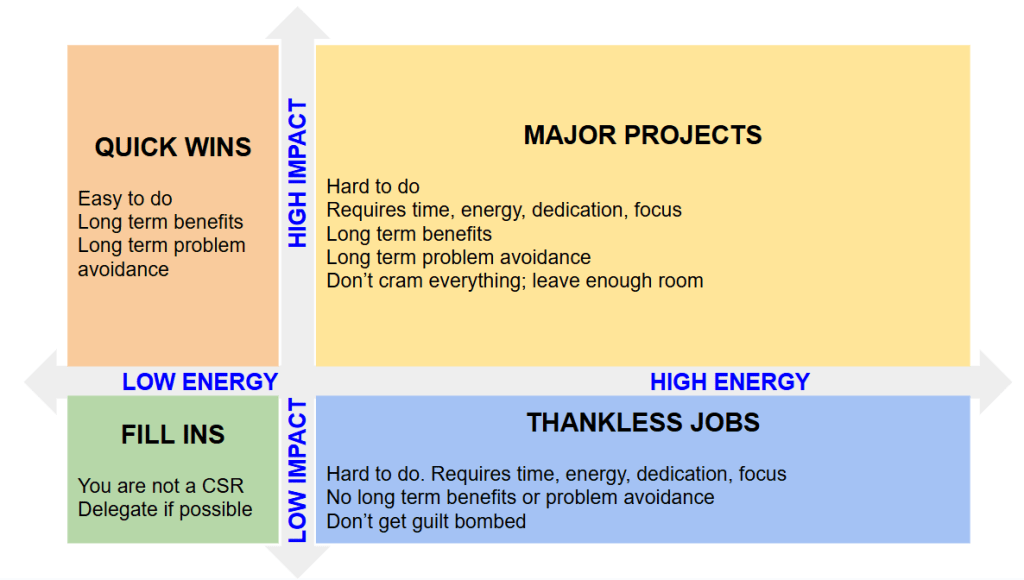
If I had been thinking about how I was using my time, here was Raghu showing me a visual of it. And I loved it!! I took this idea further and I drew a picture for myself with Section 1 really really big – like covering 80% of the box. And I put it on the desktop so that I remind myself multiple times a day where 80% of my time and energies should go towards.
Now it matters less whether Section 1 is 60% or 70% or 80%. It should be the biggest. And the moment you make it the biggest, the other 3 Sections are going to attack Section 1 for more space. And it’s going to be a constant battle. Therefore you need to have habits and processes to win this daily battle. ( I am not a life coach so I will refrain from giving advice on the specifics. Instead, please read and re-read Essentialism by Greg McKeown for advice on this.)
What are my Section 1 items?
- My health
- My family
- My work
- My small circle of friends
What should your Section 1 be like?
- Only you know that. But whatever you put in it, protect them and work on them.
- Being prompt in answering phone calls and WhatsApp messages shouldn’t be in Section 1 🙂
—
When you start prioritizing what is important to you, people will think you are selfish. Take it as a compliment because it means you are improving. Can somebody else accomplish your goals for you? Can somebody else take care of your physical and mental health? No and no! Only you can. So if you have to prioritize what is important to yourself it will mean saying no to a lot of things and a lot of people.
Devdutt Pattanaik, in one of his books says that Sri Krishna was so involved in helping the Pandavas that he neglected his own duties as a father. Well, if god cannot be in multiple places doing multiple things, what chance do you and I have? So we must say No to a lot of things and become selfish. Nobody can do it all; nobody can have it all; nobody can be it all.
—
Manisha Koirala is a cancer survivor. I read some of her interviews and she describes her current life as a second chance at life. She now values her life and her time even more because she came very, very close to death. Not many are lucky to have a second chance. We don’t have to go through an experience like that to realize what we already have.
An uncle of mine turned 70 and I called to wish him. He jokingly said – 70 years and achieved nothing. But somewhere there was a regret that he could have done so much more with his time and with his life. That is a regret we can all avoid.
-Cheers!
 Interest upon Interest
The article was eye-opening. I’m also making an effort to incorporate this as much as possible.
However, Vikas, I have a question.
Wouldn’t you prioritize section 2 over section 1 due to its high ROI nature—requiring less energy but delivering high impact?
One example of section 2 could be, spending 10 minutes with the kids every morning, before going to office.
Additionally, there is a minor typo (which may benefit future readers)—”Section 2: Low Energy. Low Impact. (Quick Wins)” should be corrected to “Section 2: Low Energy. High Impact. (Quick Wins)” as it briefly confused me too.
LikeLike
As always, thanks Vasanth for reading my blog and sharing your thoughts.
First of all- thanks for pointing the type out. I have corrected it.
You are right- Quick Wins are like low hanging fruits. But how many such fruits are there? Writing this blog (high impact – high effort) took me an entire day. Correcting the typo (also high impact) took me a minute. But which one is harder to do? I had heard/ read that Poincare the great Mathematician didn’t bother correcting his mistakes while writing because he thought it to be a waste of his time 🙂
I am not opinionated on this Vasanth. If you have more examples do share.
LikeLike
Hi Vikas,
As you rightly mentioned, quick wins are comparable to low-hanging fruits. Thus, I was contemplating why we shouldn’t prioritize them over section 1.
Here’s how I see it: Always opt for high-impact tasks, but it’s wise to prioritize those requiring low energy over the high-energy ones. Additionally, I concur with your view that “Low Energy. High Impact” scenarios are quite rare, but we should remain vigilant for them, much like the approach in special situations investing—which, by the way, is rare.
If Poincare wrote books without bothering to correct mistakes (I’m not referring to trivial grammatical errors), there’s a considerable chance that readers could be led in the wrong direction.
Here are a few examples of such scenarios:
I’ve also observed that some things transition from high-energy to low-energy tasks once we’ve become proficient. In the case above, the code changes became easier for me, but it took me several years to reach that level. The key takeaway is to consistently look for low-energy, high-impact situations in life. It’s an advantage we shouldn’t overlook.
LikeLike
Thanks Vasanth for sharing your thoughts. It helped clarify some things for me. What you classify as Section 2, I was doing so in Section 1 without much thought of classification.
What I was thinking of Section 2 would be things like filing taxes on time (long term problem avoidance).
LikeLiked by 1 person
thanks visak
LikeLike