
It’s the strong swimmers who drown.
-Anonymous
I am a good swimmer. There was a time when I had gone to Goa with some friends. We saw some American kids who had swum a little distance off the coast onto a rock in the sea. So a friend of mine and I decided to do the same – after all I am a good swimmer, aren’t I?
So first of all, it had been months since I had done any kind of a cardio exercise- so I was low on stamina. And then we had to swim against the tide. And unlike a swimming pool, this was the sea with no boundary walls. As we started swimming, I found myself tiring out and being breathless. I realized my big mistake and for the first time in my life I thought I was going to drown and die. I really panicked!
But slowly, I managed to gather my wits and a little by little I managed to swim unto that rock and save myself. The way back was easier because it was with the tide.
Now imagine, if I hadn’t known how to swim, would I have even attempted it? No, of course not! I took on a risk I needn’t have only because I over estimated my capabilities and underestimated the risk.
If I survived this, it was because I was lucky.
—
You may have read this Amar Chitra Katha story.
There were four students walking through a jungle; three were brilliant and the fourth was a dud. They come across a tiger’s carcass. The three brilliant ones say – we will now put to use what our teacher has taught us and bring this tiger to life. The fourth one who has limited capabilities but knows his limitations says – this looks dangerous, so I’ll climb up and hide in a tree.
The three brilliant ones bring the tiger to life and the tiger devours them in return. The fourth one survives.
Again, the same theme. The brilliant ones, the strong swimmers who are confident or maybe over confident and underestimate risk are the ones most prone to life threatening dangers. It’s the ones who are talented and successful doing something will be the ones paying less attention to risk. The successful shorter, the successful fund manager, a bull market are all the ones make you pay less attention to risk.
The ones with limited capabilities but with the humility to know their own limitations and therefore the unwillingness to play with danger are the ones that survive.
—
I asked ChatGPT to list successful professionals who died during an act. And here is what it told me.
| Name | Known For / Previous Successes | Daring Act That Led to Death | Year of Death |
|---|---|---|---|
| Amelia Earhart | Aviation pioneer, first woman to fly solo across the Atlantic | Disappeared attempting to circumnavigate the globe | 1937 (presumed) |
| Robert Falcon Scott | British Royal Navy officer, led early Antarctic expeditions | Died during return from the South Pole expedition | 1912 |
| Karl Wallenda | Legendary high-wire artist, founder of The Flying Wallendas | Fell while walking a high wire between two buildings | 1978 |
| Yuri Gagarin | First human in space | Died in a jet crash during a routine training flight | 1968 |
| Jessi Combs | Professional racer and TV personality, “Fastest Woman on Four Wheels” | Crashed while attempting to break her own land-speed record | 2019 |
| Dan Osman | Extreme climber known for “rope jumping” and free soloing | Fell while rope jumping off a cliff due to rope failure | 1998 |
| Steve Irwin | Wildlife expert and TV host (“The Crocodile Hunter”) | Fatally stung by a stingray while filming a documentary | 2006 |
| Felix Baumgartner (survived) | Famous for high-altitude parachuting and base jumping | Did survive a supersonic skydive from the stratosphere | — (survived) |
| Valery Rozov | Renowned BASE jumper and Red Bull athlete | Died during a wingsuit BASE jump from Ama Dablam in Nepal | 2017 |
| Michael LeMoyne Kennedy | Son of Robert F. Kennedy, lawyer and political activist | Died in a ski accident while playing football on skis | 1997 |
| Daredevil Nik Wallenda’s ancestors | Multiple high-wire performers in the Wallenda family | Several family members died in falls during stunts | Various |
| Guy Garman (“Doc Deep”) | Diving physician attempting a world record deep dive | Died attempting a 1,200-foot (365m) scuba dive | 2015 |
| Mark Sutton | Wingsuit flyer, performed Bond stunt in 2012 Olympics | Died in wingsuit accident in the Alps | 2013 |
| François Reichelt | Tailor and inventor of an early parachute design | Jumped from Eiffel Tower to demonstrate invention (fatal) | 1912 |
Note: All of these people were successful professionals in their field. It’s not like they woke up one day and decided to do a stunt. They had been doing this for years and years.
But what they did or didn’t factor in was that they could be successful 999 times out of 1000. But the one time they aren’t because of say bad luck, it’s game over for them.
I am a huge fan of Tom Cruise. Imagine you are worth say $ 500 M or more and are 60+ years old and yet you have the hunger to train insanely and perform those mind blowing stunts. I look up to him and I hope to be as good as him in my field, some day. But, apparently, no insurer is willing to insure Tom Cruise and Jackie Chan. The insurance companies think these guys are a big risk and just because they have survived their death defying stunts so far does not mean they will always be lucky. I have to admit, the insurance companies are right in their thinking.
—
And this is a lesson we need to take from life into business and investing – to avoid situations that can mean game over for the professional and his investors.
Gabe Plotkin was a celebrated fund manager and his fund Melvin Capital delivered returns of 30% CAGR between 2014 and 2020. At it’s peak, his fund managed a capital of $12.1 B. He had successfully shorted companies like Sears and JC Penney and made money for his fund. His fees in 2020 was a mere $ 850 M. 🙂
Around 2020, one of his moves was to short GameStop, a failing electronics game retailer. He expected to sell high and buy low. Instead, a bunch of everyday people ganged up to teach Wall Street a lesson and decided to buy Gamestop and drive it’s prices higher and higher. How high? GameStop went from $17 to about $500!
So Plotkin had to cover his short position by paying a massive amount. How much? $ 6.8 B!!

Yet another strong swimmer that drowned!
There is a documentary on Netflix (Eat the rich) and a movie on YouTube (Dumb Money) on the GameStop saga.
—
Here are two big takeaways:
- Great or good outcomes don’t justify the process. For example – Just because I survived, doesn’t mean it was great thinking or great process. It was actually anything but thinking.
- Track records don’t matter where the downside risk is fatality or bankruptcy or major loss. Walk away if people throws track records at you.
—
Whenever anybody asks me why I switched to investing, I answer: because of Warren Buffett. His letters inspired me to seek compound interest and taught me how to think, how to behave and even how to live. He is my hero.
Below are some quotes by Charlie Munger which has been mentioned by Warren Buffett in his Letter to shareholder, 2022. Hope you see the similarity with what I have been saying so far.
The world is full of foolish gamblers, and they will not do as well as the patient investor.
All I want to know is where I’m going to die, so I’ll never go there. And a related thought:
Early on, write your desired obituary – and then behave accordingly.There is no such thing as a 100% sure thing when investing. Thus, the use of leverage is
dangerous. A string of wonderful numbers times zero will always equal zero. Don’t count
on getting rich twice
Take these advice of Warren Buffett and Charlie Munger. They have helped me survive and they will help you too.
And ignore what Warren Buffett and Charlie Munger have said below:
Here is what they said:
- Sometimes opportunities present themselves where it is advisable (by them) to invest75% or 100% or even 120% of your net worth in a single stock. Dear Charlie, but you said leverage is dangerous. And you said there is no such thing as 100% in investing. And you also said All I want to know…I know I don’t want to get poor so, so much concentration in one stock is a good idea?
- Professional managers should concentrate. Dear Warren, but those people who died tragically were professionals too in their field but ignored the downside risk. Concentration increases downside risk. I don’t want to become an addition to that list.
I think Warren Buffett and Charlie Munger have done some disservice to investing by advocating a concentrated portfolio (75%+ in some ideas once in a while). A lot of investors that look up to them might now try this and what if they aren’t as good or as lucky as them?
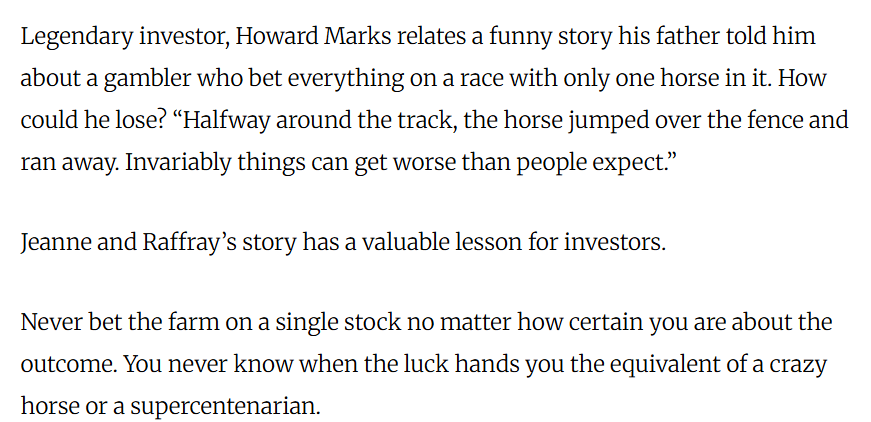
And Warren and Charlie didn’t probably hear of this anecdote from their friend Howard Marks. This is from a blog written by my friend Anshul Khare. Source: https://www.safalniveshak.com/how-not-bet/.
—
Warren Buffett may have had hamburgers, had Coke which made him happy and snacked on See’s Candies and lived to 95, but I wouldn’t take eating advice from him. Likewise, he may have survived despite concentration in some stocks, but does not mean I will too.
Portfolio concentration is how you become rich fast. It is also how you can lose money fast. All I know is, I don’t want to get poor (neither fast, nor slow)…and so I don’t want to do things that will take me down that path.
And Warren you also said something like:
You don’t want to trade what you have and what you need for what you don’t have and what you don’t need.
I already have a good life and my portfolio is doing reasonably well. Why would I want to trade what I have and need (like a good night’s sleep and reasonable amount of money) for what I don’t need (like risk of ruin)? More money won’t buy more happiness but less money will certainly bring more misery. And I don’t want misery.
Thank you Warren and Charlie for the good advice on not leveraging, not approaching investing like gamblers and to be content. At the same time, I am choosing to ignore your advice on leverage and concentration.
-Cheers!
 Interest upon Interest
PS: In case you are wondering, how concentrated am I? My top holding accounts for 20% of my portfolio and my top 10 account for about 65%. Note: it’s as a % of my portfolio and net worth. And I have investments outside my portfolio too. Which means that my top holding accounts for a small % of my net worth. Why am I so diversified? Because I wish to survive the ups and downs of the market for the next 30 to 40 years. I believe, if I survive, I will thrive.
My net worth is not my self worth. I know the easy pitches will come but I need to stay not out for that. And one way I figured is to not overly concentrate. And to sell when stocks become to expensive. (For example when my top holding went above 21% I sold some to bring it below 20%.) Even, I am tempted to go for the big hits, to concentrate and concentrate heavily, but then again I am reminded of the race with one horse in it. I’d rather be the dumb kid who knew his limitations and survived than try to be something which I am not.
LikeLike
Very insightful article, Vikas.
Overconfidence kills (Concentrated bets).
Ignorance is bliss (index investing).
I am trying to be somewhere in the middle. I started with concentrated investing (10 stock portfolio) but slowing shifting to 18-25 stocks portfolio.
I understood, in order to test my skills (and learn more), I need to turn as many stones as possible.
I understood, I can never do deep research like analysts (so I subscribed to some good research services) but I am trying to maximize my common sense (by not buying fads, learning to wait, not buying over leveraged companies, etc) to generate the alpha.
I understood, even if I do not beat index, the knowledge I would have got in this process would be very beneficial in other aspects of my life.
LikeLike
Vasanth – with that kind of humility you will be far ahead of most professionals.
LikeLike
Thanks for your kind words, Vikas.
LikeLike